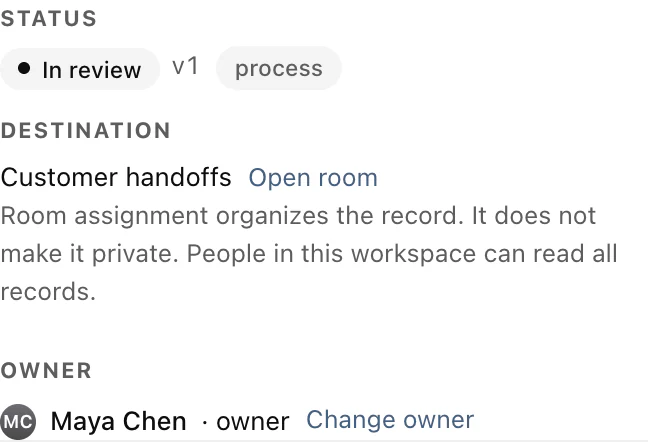
Bring the customer question into a room. Ask Riley to check the policy, then Jamie to prepare the handoff. Your people check the evidence and decide what happens next.
“Check order eligibility and stock before offering a replacement.”
Explain the correction to a teammate. Review its proposed training rule before reuse. See how teaching works →
One room. Different contributions.
A customer question becomes a clear next step.
Ask one teammate to find the policy and another to prepare the handoff. You direct both contributions in the same room, with approved company knowledge behind the work.
Source connection + supplied ticket
The plan changed. The invoice did not. What happened?
01
Bring the question
The customer upgraded their subscription, but the latest invoice shows the old plan. They ask whether they were charged twice.
02
Direct the two contributions
Ask Riley to check approved billing policy. Review the facts, then ask Jamie in the same room to prepare a handoff with the missing checks and billing owner.
03
Confirm, then send
Billing verifies the current invoice and payment record. The rep updates the draft and sends the reply in Zendesk.
The plan display does not prove a second charge. Billing will check the invoice, payment record, and any adjustment before support confirms the outcome.
Your team decides the next step
Bring a sanitized Zendesk ticket excerpt. A configured Notion connection imports policy material for approval; neither teammate looks up the live billing account.
Supplied deal notes + source connection
Parker separates the promised scope from the next request.
01
The discovery notes
Provide deal notes asking for a weekly catalog report and live inventory sync, alongside the approved reporting offer.
02
The teammate’s part
Parker uses the approved offer guidance to separate the weekly CSV reporting pilot from the live integration work that needs scoping.
03
The deal owner’s decision
The rep confirms what is included, asks about the missing inputs, and uses the checked outline in the buyer follow-up.
Check the carrier record and fulfillment status before offering a replacement or a delivery date.
Your team decides the next step
Use ticket and order notes supplied by your team. Check current order details in Shopify before taking action.
Inside AI teammates
Set up the teammate for its part of the work.
Give it a job
Start with the work you need done.
Give Riley the policy check and Jamie the handoff. Choose each teammate’s model, instructions, room and person to run with.
Each teammate has a job and a person to run with.01 / 03
Teach your method
A correction should help next time too.
Try a ticket example. Correct a mistaken assumption and explain why. Review the proposed training rule before that teammate uses it again.
An example, a correction, then a rule to review.02 / 03
Bring it into the room
Keep the question and the answer together.
Keep the question, cited reply and follow-up in one room. Teammates use their assigned room and approved shared company memory by default. Grant access to other rooms explicitly.
Keep the room and the person responsible with the record.03 / 03
You direct their contributions in a shared room. Ask one teammate to check the policy, review its answer, then ask another to prepare the handoff. Teammates do not automatically delegate work to each other.
Can different teammates use different models?
Yes. A teammate has its own model choice. The models available depend on your workspace configuration. Changing the model does not change its access permissions.
Is training shared with every teammate?
No. Approved training rules stay with the teammate you teach. For team-wide reuse, create a separate shared skill and review it.
Does training change the underlying model?
No. Training creates reusable instructions for that teammate. Your examples and corrections do not fine-tune the underlying model.
How is an external agent different?
An AI teammate is built and trained in Them AI. An external agent runs elsewhere and connects through MCP with its own key and retrieval scope.
Bring one real workflow
Try it on work your team already does.
Choose one recurring question, bring the source material, and name the person who will review the answer. Start there, then decide what is worth repeating.
Mac-only for now. Free during the beta (invite-only). Have a workflow in mind? Plan a pilot with us.





 Zendesk
 Notion
 Them AI Prepared for review