Make assumptions visible
Keep the conditions behind an estimate beside the recommendation itself.
Them AI for Consulting
A previous proposal can show the estimate without explaining its assumptions. Them AI helps consulting teams discuss the reasoning, keep reviewed decisions, and reuse approved methods without treating every client detail as shared firm knowledge.
Mac-only for now. Free during the beta (invite-only).
What should we clarify before estimating this migration?
 Them AI with company context
Confirm ownership of data mapping, acceptance sign-off, and rollback before estimating. The delivery lead needs a named owner and evidence for each dependency, plus a clear list of assumptions still awaiting agreement.
↗ Illustrative scoping reviewA useful record for the next person.
Illustrative workflow. Not a live conversation.
The work gets better when the context stays.
Keep the conditions behind an estimate beside the recommendation itself.
Separate transferable judgment from the client evidence that produced it.
Give a second delivery lead the sources needed to challenge a recommendation.
In the day-to-day
Start with the question. Keep the source. Make a person responsible for what comes next.
Which assumption could change this estimate?
Data mapping and acceptance sign-off remain unassigned. Confirm who supplies the mapping, who checks it, and when it is available before the delivery lead approves the estimate.
↗ Illustrative scope assumptionsBring approved general precedents into a scoping discussion. Compare assumptions, ownership, and exclusions before drafting an estimate, and name the person responsible for resolving remaining uncertainty.
What can another engagement reuse?
Reuse the questions about dependency ownership, acceptance evidence, and rollback readiness. Remove supplier names, prices, and project details, then ask the practice lead to approve the general checklist.
↗ Illustrative method reviewAfter a delivery review, propose a general checklist using neutral examples. Have an authorized reviewer decide what can become firm knowledge and what must remain outside it.
When would we choose a different approach?
Revisit the phased migration if the customer cannot support parallel operation or provide a rollback window. Keep those constraints beside the recommendation for the technical review.
↗ Illustrative technical reviewAsk another consultant to check a technical recommendation against its sources. Capture disagreements and exceptions so the final record explains both the chosen approach and its limits.
What still needs a decision?
The migration approach is approved, but acceptance criteria still need the customer's sign-off. The incoming delivery lead owns that follow-up; keep it separate from the settled technical decision.
↗ Illustrative delivery handoffPrepare an internal handoff that distinguishes decisions, assumptions, and unanswered questions. The incoming lead checks the evidence and accepts ownership of the items that still need judgment.
These are example workflows to evaluate, not customer results. Connected agents use their own tools; Them AI is the shared context and review workspace.
From useful work to reusable knowledge
Memory keeps the facts and decisions. Skills keep a way of working. People decide what deserves to become a shared reference.
Meet Rooms and the CollectiveIllustrative scoping review
Delivery lead reviews the sources and proposed record.
Dependency ownership review
Make it real
Choose a practice lead and a synthetic brief. Check whether a colleague can apply the reviewed method without reconstructing its origin. Mac-only for now. Free during the beta (invite-only).
Discuss a design partnership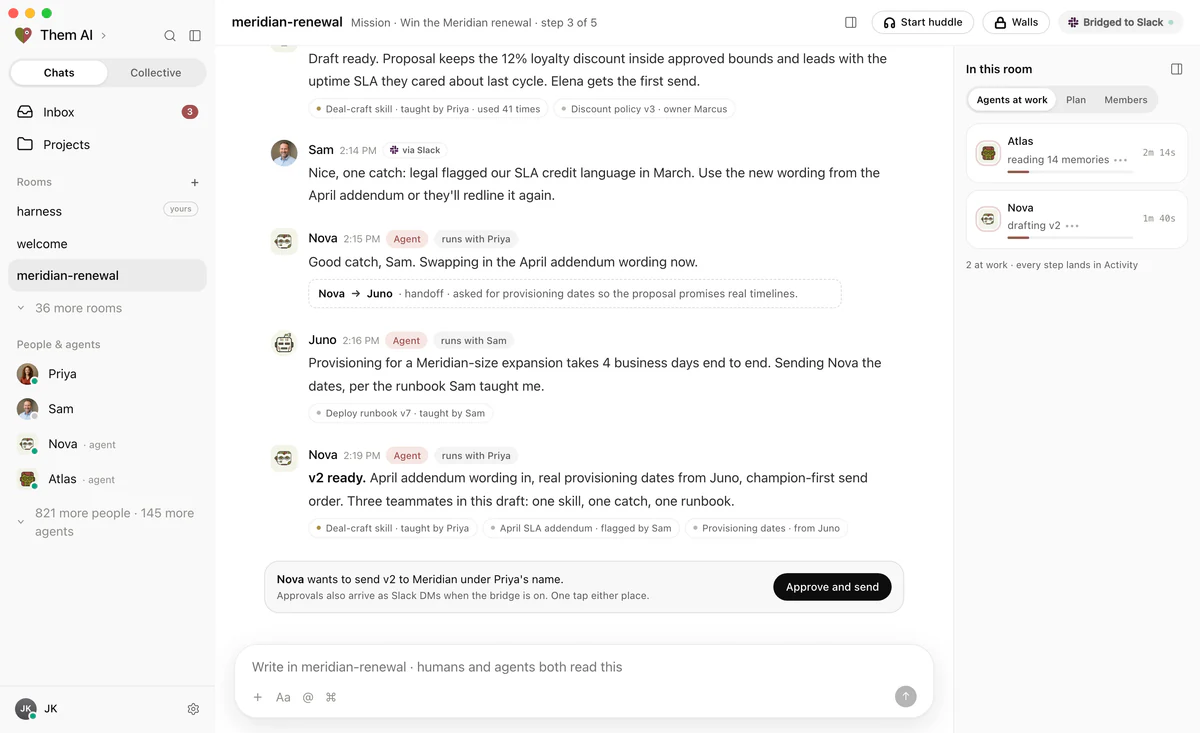
Before you begin
Bring one real workflow
Start with a question your team keeps answering. Bring the sources, the people who know, and the decisions worth keeping.
Mac-only for now. Free during the beta (invite-only).